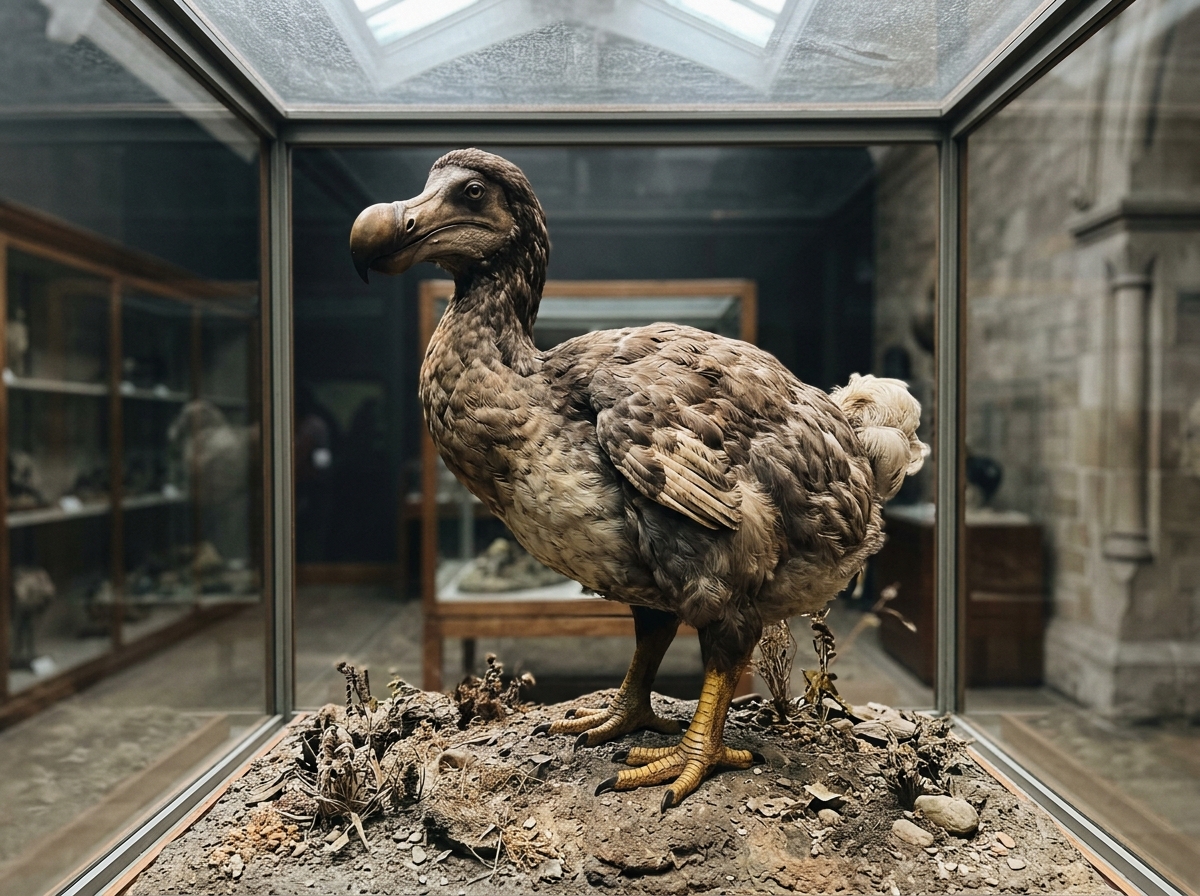
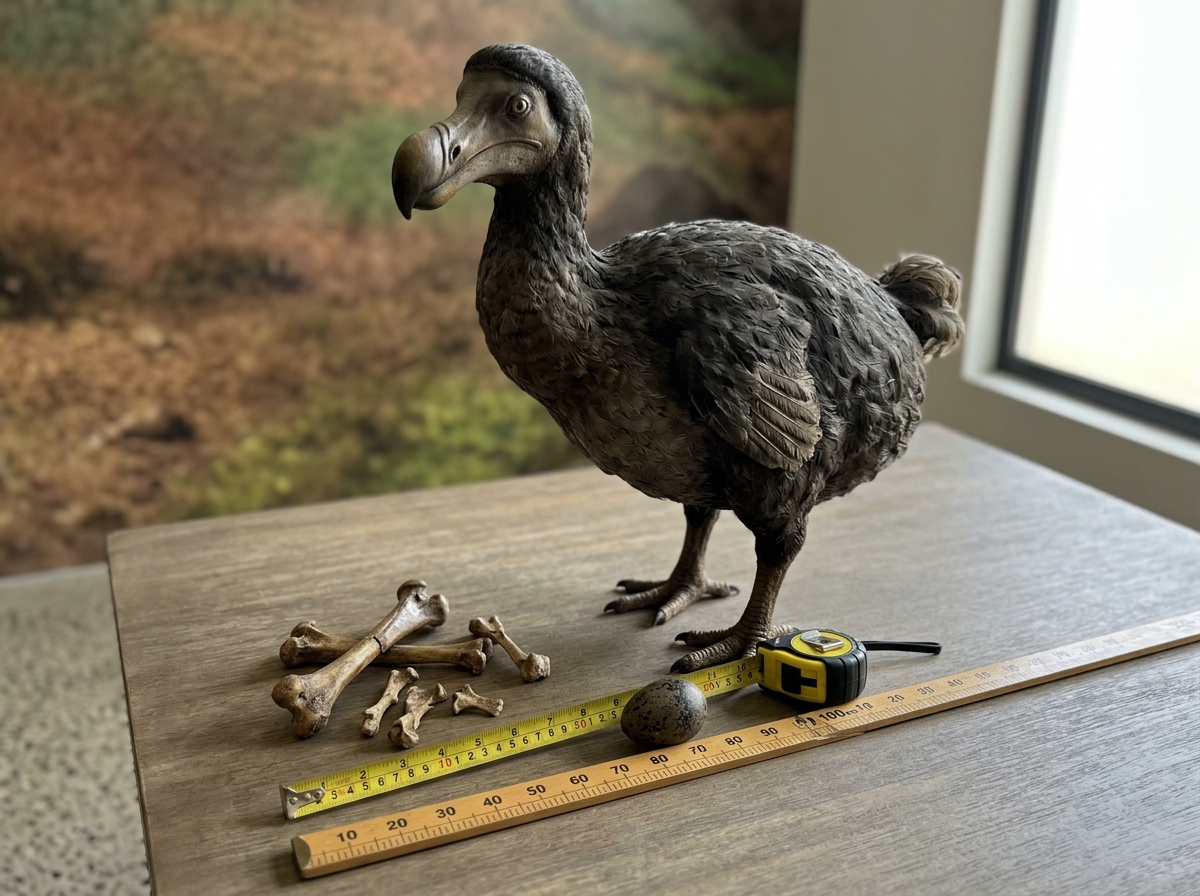
A dodo was roughly the size of a large turkey or a very stocky swan. Most modern scientific estimates put a typical adult dodo somewhere between 62 and 75 cm tall (roughly knee-to-hip height on most adults), about a metre in body length, and somewhere between 10 and 17 kg in weight depending on the individual and the estimation method used. If you have seen a museum figure quoting around 20 kg, that comes from older or more generous reconstructions. If you have seen 10 kg, that comes from more recent skeletal analyses. Both are working from the same scarce evidence, just interpreted differently. Here is the full picture.
How Big Is a Dodo Bird? Size, Weight, and Egg Facts

Maya Hennessy
23 Mar 2026
Typical dodo size: height, length, and weight
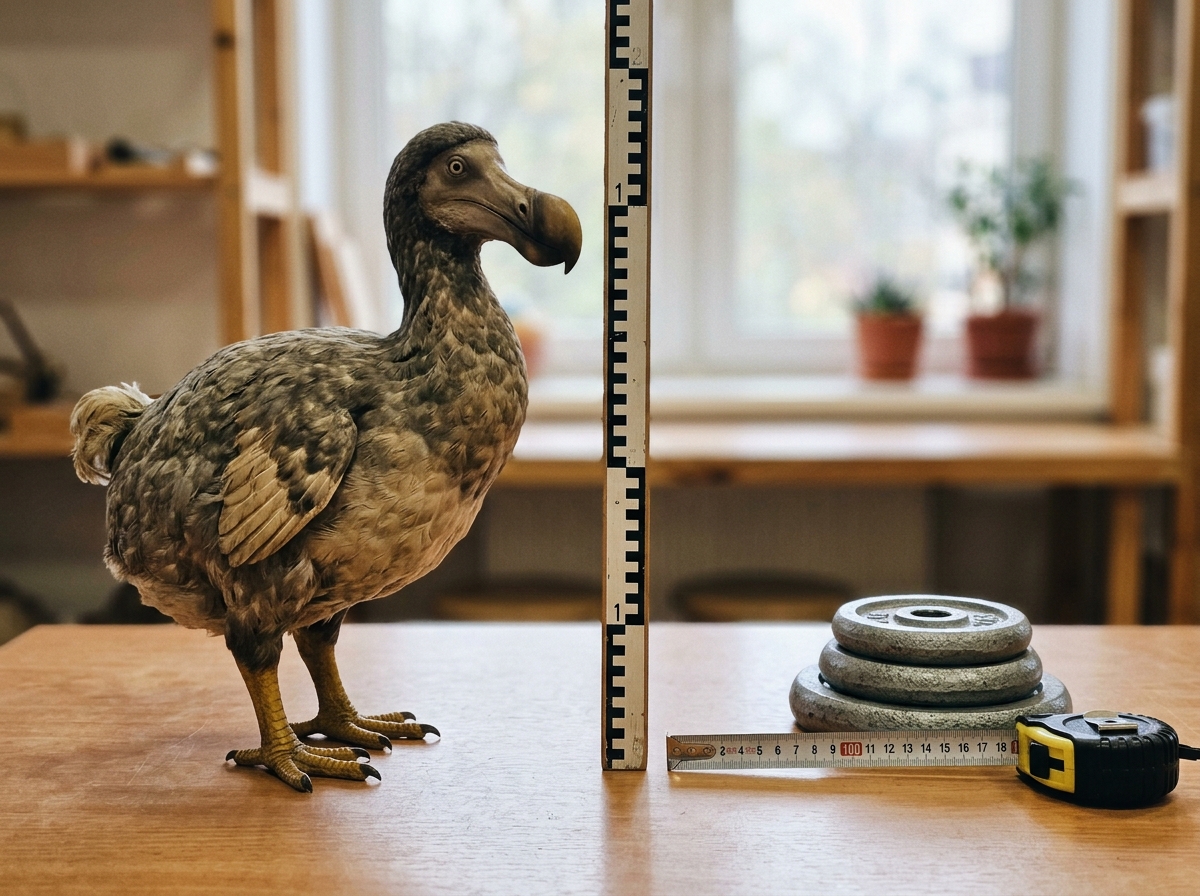
The most commonly cited dodo measurements come from subfossil bones recovered primarily from Mauritius, combined with historical illustrations and written accounts from 17th-century Dutch sailors and traders. Pulling those sources together gives a working size range that most researchers accept as a reasonable baseline.
| Measurement | Conservative estimate | Higher estimate | Commonly cited museum figure |
|---|---|---|---|
| Height (standing) | ~62–65 cm | ~75 cm | ~1 m (Oxford Museum) |
| Body length | ~65–75 cm | ~100 cm | ~1 m |
| Body mass | ~10–12 kg | ~17.5 kg | ~20 kg (Oxford Museum) |
The Oxford University Museum of Natural History describes their famous Oxford Dodo reconstruction as 'about a metre tall' and weighing 'about 20 kg.' That is the number a lot of people remember from museum visits and textbooks. But a major synthesis paper published in PeerJ, which used the largest sample of dodo bones analyzed to date, puts mean body mass closer to 12 kg. A separate volumetric study using CT-calibrated convex hull reconstruction estimated eviscerated body mass at 8.0 to 10.8 kg, with the authors cautioning that converting that to live mass requires adding corrections for organ mass. So the honest scientific answer right now is: somewhere between roughly 10 and 17 kg, with 12 kg being a reasonable central estimate for a typical wild adult.
In terms of build, the dodo was wide-bodied, short-legged, and heavily built relative to its height. It had a large hooked beak, tiny vestigial wings that served no flight function, and a small tuft of tail feathers. It walked on two sturdy legs and held itself upright in a somewhat hunched posture. If you imagine a very rotund, ground-dwelling pigeon scaled up to roughly turkey size, you are close to the mark, which makes sense given that the dodo was actually a member of the pigeon and dove family.
How researchers figure out dodo size from bones and old accounts
No living dodo has ever been measured by a scientist. Every number you see comes from one of three sources: subfossil skeletal remains, historical written descriptions from people who saw live dodos between roughly 1598 and 1662, and illustrations produced during or shortly after that period. Each source has real limitations.
Working from bones
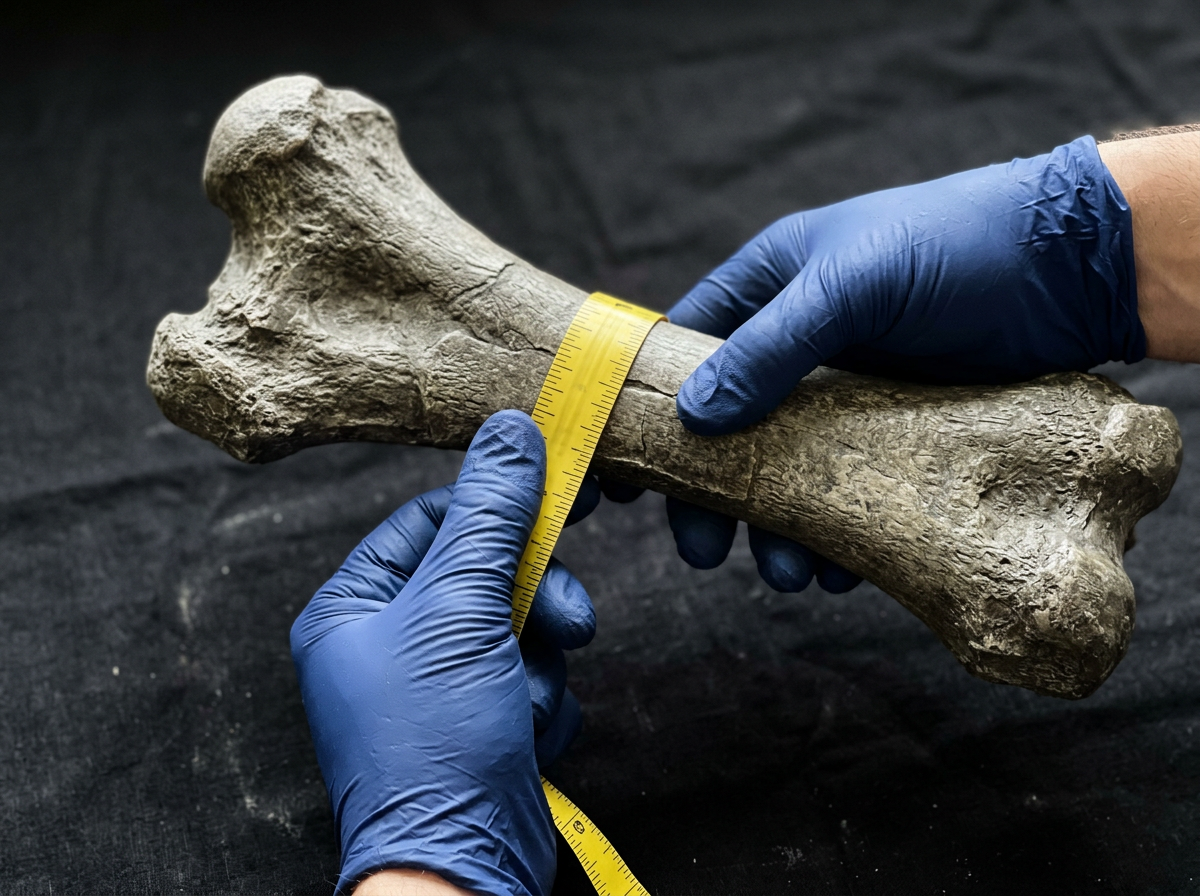
The primary modern method for estimating dodo body mass involves measuring specific leg bones, most usefully the femur (thigh bone), the tibiotarsus (lower leg), and the tarsometatarsus (the foot bone above the toes). Researchers then plug those measurements into predictive equations built from relationships observed in living birds. The catch is that the dodo sits outside the normal size range of its closest living relatives, which introduces uncertainty into any regression-based extrapolation.
The PeerJ synthesis study found that femur circumference performed better as a mass predictor than femoral length or diameter alone, or than measurements taken from the tarsometatarsus or tibiotarsus. Different researchers using different bone measurements and different calibration datasets (for example, Livezey in 1993 versus Angst and colleagues in 2011) produced quite different results, which is exactly why the published mass estimates for dodos span such a wide range.
The CT-based convex hull approach is more recent and arguably more rigorous. It works by digitally wrapping a convex shape around each segment of a reconstructed dodo skeleton (skull, trunk, femur segment, tibiotarsus and fibula, tarsometatarsus, and feet), calculating the enclosed volume, and then converting that volume to mass using calibration data from CT-scanned modern pigeons. It avoids the extrapolation problem of leg-bone regressions but introduces its own sensitivity issues, particularly around how the trunk is reconstructed and how missing organs are accounted for.
Historical descriptions and illustrations
Written accounts from Dutch sailors described the dodo as a large, clumsy, heavily built bird that was easy to catch. Some accounts described birds weighing roughly 25–30 Dutch pounds, which translates to a range that fed early high mass estimates. But historians of natural history have pointed out that these accounts were not systematic measurements, they were impressionistic, and some of the fattest depictions in early illustrations were likely captive birds kept on ships and overfed. The consensus in recent paleontology literature is that early illustrations and accounts probably overstated body mass and that wild dodos were leaner than the famous rotund museum reconstructions suggest.
How big was a dodo bird egg
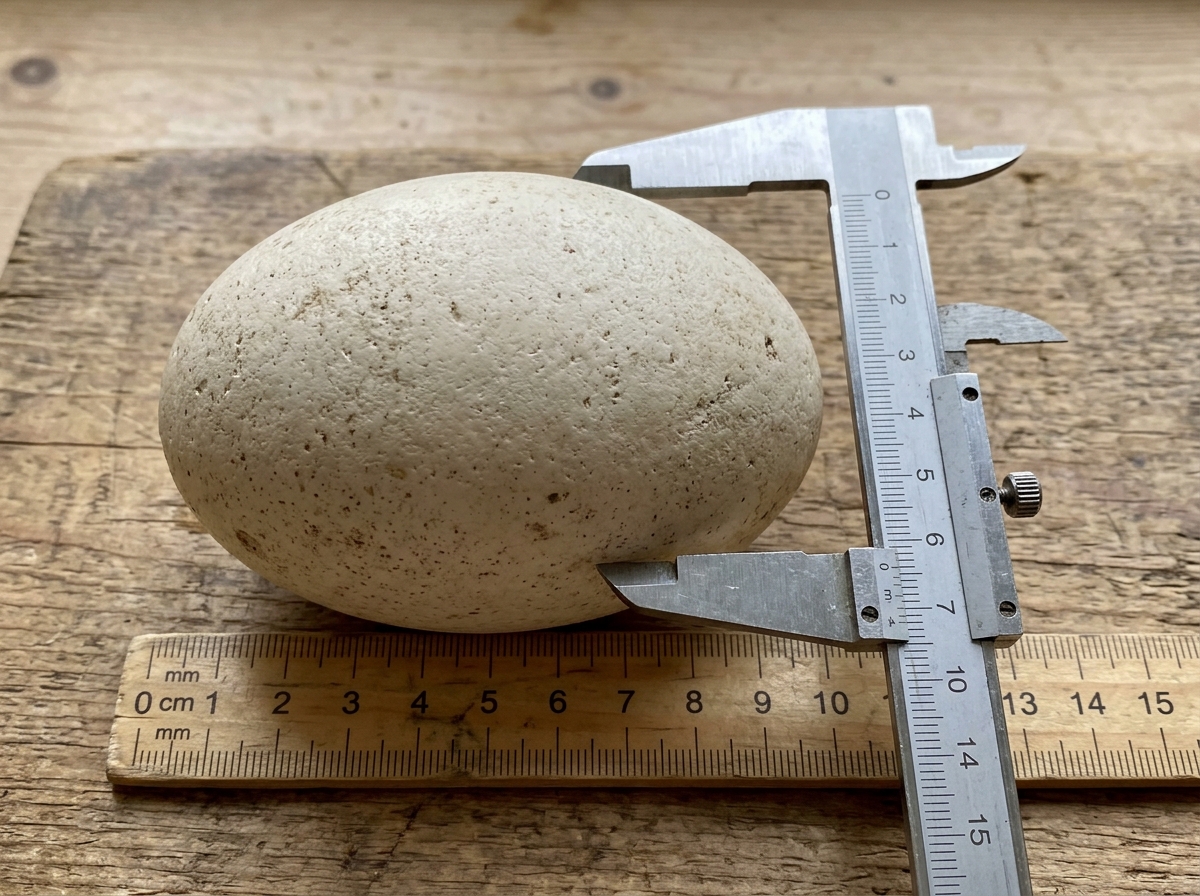
This is where the evidence gets genuinely thin, and it is worth being upfront about that. No confirmed, intact, measured wild dodo egg exists in any museum collection in the world. Egg size estimates for the dodo are inferred, not measured directly from known authentic specimens.
The most commonly referenced estimate puts a dodo egg at roughly 11 to 13 cm in length and about 9 to 10 cm in diameter. Those figures come from comparative and inferential approaches: researchers scale expected egg size against body mass using relationships observed in living birds (including other large flightless species), and they factor in the one specimen that has attracted the most attention, the egg held by the East London Museum in South Africa.
The East London Museum egg has a complicated history. Its provenance was documented through a letter discussed as far back as 1953, and its attribution to the dodo has been disputed. A 2010 news report described an active dispute over whether the egg is genuinely from a dodo at all. The museum displays it as a significant specimen, but the scientific community has not reached a settled consensus on its authenticity. That context matters: it means the single most-cited candidate for a real dodo egg carries genuine uncertainty about what species it actually belongs to.
Using body mass scaling as a rough cross-check, an adult dodo at around 10 to 12 kg would be expected to produce an egg noticeably smaller than an emu egg (emus weigh 45 kg and produce eggs roughly 13 cm long) but larger than a typical domestic chicken egg. An egg in the 11 to 13 cm range is plausible and consistent with what we know about egg-to-body-mass ratios in large flightless birds, but it is an informed estimate rather than a confirmed measurement. Treat any precise figure you read about dodo eggs with appropriate caution.
Dodo size compared to modern flightless birds
Abstract measurements are easier to grasp when you can place them next to something familiar. Here is how the dodo stacks up against the major living flightless birds you are likely to encounter in reference material or at a zoo.
| Bird | Approximate height | Approximate weight | Egg size (length) |
|---|---|---|---|
| Dodo (extinct) | ~65–100 cm | ~10–17 kg | ~11–13 cm (estimated) |
| Ostrich | up to ~2.75 m | over 150 kg | ~150 mm (~15 cm) |
| Emu | over 1.5 m | over 45 kg | ~13 cm |
| Southern cassowary | 1.2–1.7 m | up to ~76 kg (female) | not directly comparable |
| Kiwi (North Island brown) | ~40–45 cm | ~2–3 kg | proportionally very large |
The comparison makes clear that the dodo was a mid-sized bird by flightless-bird standards. It was far smaller than an ostrich, emu, or cassowary, and heavier and bigger than a kiwi. If you want the most intuitive mental image: picture a bird roughly as tall as a border collie and about as heavy as a medium-sized dog. It was stout, short-legged, and wide. The cassowary is probably the most useful comparison for overall body impression, though the cassowary is taller and much heavier. The dodo versus ostrich comparison, which you might come across in other articles on this site, highlights just how far down the size scale the dodo sits relative to the largest living ratites. dodo bird vs ostrich
One thing worth noting is that dodos were flightless and the question of why dodo birds cannot fly is a separate but related thread.
Why dodo size estimates vary so much
If you have read three different sources and come away with three different numbers, that is not sloppy research. It reflects genuine scientific disagreement driven by several compounding factors.
- Sexual dimorphism: The PeerJ synthesis paper found that natural population size variation was wide, and some of that is likely due to sex differences. Males and females may have differed meaningfully in body mass, but definitively sexing subfossil dodo bones is difficult, so most mass estimates are pooled across sexes.
- Age variation: Subfossil bone samples include individuals at different life stages. Younger, smaller birds mixed into a sample will pull mass estimates downward compared to samples dominated by fully grown adults.
- Different bone metrics: Using femur circumference, femoral length, tibiotarsus length, or tarsometatarsus length each produces a different regression line and a different predicted mass. Livezey (1993) working from one set of measurements got a high male estimate of around 21 kg. Later researchers using different metrics and methods got 10 to 12 kg. Neither group made errors; they used defensible methods that happen to produce different outputs.
- Regression extrapolation limits: Predictive equations built from modern birds work best within the size range of those calibration species. The dodo sits outside or at the edge of the pigeon-family size range, so extrapolating regressions to dodo-sized bones introduces real uncertainty.
- Captive versus wild individuals: Some historical descriptions and possibly some specimens reflect birds that were captive or semi-captive, likely in poorer or better condition than free-ranging wild birds. Captive dodos brought to Europe on ships may have been unusually fat, skewing historical written accounts.
- Dating and taphonomy: The condition of subfossil bones affects which measurements can be taken reliably. Incomplete or distorted specimens introduce noise into any morphometric analysis.
The honest bottom line is that the field has moved toward lower mass estimates over time as methods have improved, and that the Oxford Museum's '20 kg' figure represents an older, higher estimate that most current researchers would consider too large for a typical wild dodo. A range of 10 to 17 kg, with 12 kg as a central working estimate, is where the weight of current evidence sits, essentially the dodo bird verdict on mass based on the best available data.
Quick answer and how to verify what you find
Here is the short version: a dodo was roughly 65 to 100 cm tall, about a metre in body length, and most likely weighed somewhere between 10 and 17 kg in the wild, with 12 kg being the best current central estimate. Its egg was probably around 11 to 13 cm long, but that figure is inferred from scaling relationships rather than measured from authenticated specimens. Any source quoting 20 kg or more is using older estimates; any source quoting a precise egg measurement as confirmed fact is overstating the evidence.
If you want to check any of these figures yourself, the most reliable places to look are peer-reviewed paleontology and ornithology journals (particularly PeerJ, which has published two major dodo mass studies in open-access format), the collections pages of major natural history museums like the Oxford University Museum of Natural History and the Natural History Museum in London, and established reference works on extinct flightless birds. When you read a size claim, look for whether it is based on skeletal measurements with a stated methodology or whether it is simply repeating an older museum description. The difference matters quite a bit for a species where the entire physical record amounts to a few hundred subfossil bones.
For broader context on the dodo, it is also worth reading about where dodos actually lived (the island of Mauritius in the Indian Ocean), why they could not fly, and how their speed and mobility on land compared to what early accounts suggested. Compared to how their speed and mobility on land compared to what early accounts suggested.
FAQ
How big is a dodo bird compared with a modern turkey?
In height and body length it is roughly in the turkey range, about 62 to 75 cm tall and around a metre long, but it looks different because it was much shorter-legged and wider-bodied (more stocky, more hunched), so it can appear bulkier even at similar height.
If a museum says a dodo weighed about 20 kg, is that totally wrong?
It is not impossible, but it is considered a high-end estimate. Current work based on larger bone samples and newer mass-estimation approaches typically lands closer to about 10 to 17 kg for wild adults, with about 12 kg often used as a central estimate.
Why do estimates for dodo weight vary so much from source to source?
Because there is no direct measurement of living birds. Estimates rely on different subsets of bones and different prediction methods (leg-bone regression versus CT volume conversion), and those methods handle missing tissue and organ mass differently, creating a wide spread.
Do we know the size of a dodo egg with the same confidence as the body size?
Not really. Egg dimensions are inferred, not directly measured from authenticated specimens, and the best-known candidate egg has an uncertain provenance, so any precise egg number should be treated as an informed estimate rather than confirmed fact.
What is a good “quick answer” range to remember for dodo height and weight?
A practical takeaway is roughly 65 to 100 cm tall, about a metre in body length, and most likely about 10 to 17 kg in the wild, with about 12 kg as a central working value.
Were dodos bigger in captivity than in the wild?
Likely yes, or at least early accounts and depictions may reflect captive birds. Historical descriptions sometimes emphasize clumsiness and ease of capture, and illustrations that look very rotund may involve individuals that were overfed on ships or in temporary holding conditions.
How does the leg-bone method estimate mass, and what is the main limitation?
Researchers measure certain leg bones, then use relationships observed in living birds to predict body mass. The key limitation is that dodos are outside the normal size range and build pattern of their closest living relatives, so the regression can extrapolate in a way that changes the result.
How does the CT-based approach differ from bone regression?
CT reconstructions estimate mass by reconstructing a 3D volume around the skeleton segments and converting that volume to mass using calibration data from modern pigeons. It avoids some regression extrapolation, but it is sensitive to how the trunk is reconstructed and how missing organs are accounted for.
Next Article
Can Dodo Bird Fly? The Truth and Why It Was Flightless
Answer if a dodo can fly, why it was flightless, and how evolution and anatomy shaped its extinct birds