
The bird that became extinct in Mauritius in the 17th century is the dodo, scientific name Raphus cucullatus (Linnaeus, 1758). That answer explains where was the dodo bird found. That answer is about as settled as historical natural history gets. The dodo was a large, flightless pigeon relative, endemic only to the island of Mauritius in the Indian Ocean, and it disappeared within roughly 80 years of sustained human contact. If you came here to solve a crossword, settle a trivia dispute, or verify something you read online, that is your direct answer. Everything below gives you the evidence and context to back it up with confidence.
Which Bird Became Extinct in Mauritius in the 17th Century?

Maya Hennessy
23 Mar 2026

The species and why it owns the 17th century
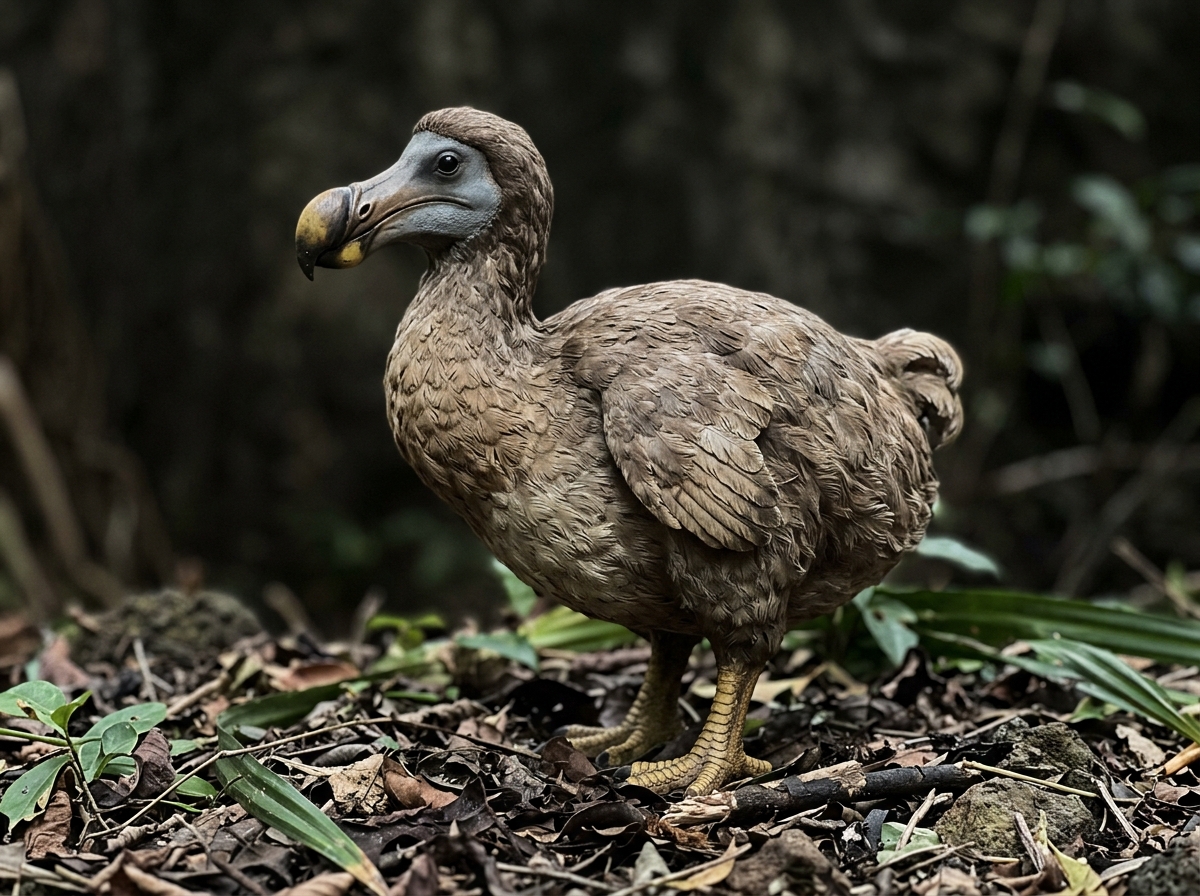
Raphus cucullatus was a roughly one-meter-tall, roughly 10-to-17 kg flightless bird that evolved on Mauritius after its pigeon ancestors arrived, an answer to how did the dodo bird evolve and found an island with no ground predators. With no need to fly and abundant food, the lineage became large and ground-dwelling over millions of years. Dutch sailors reached Mauritius in 1598 and immediately began hunting the dodo for food. The bird had no instinctive fear of humans, which made it tragically easy to catch, so if you’re asking “what bird did darwin study,” you can start with how island birds like the dodo were studied and documented after their decline. Within decades, hunting combined with the pigs, rats, cats, and monkeys introduced by settlers began destroying both the adult birds and their ground-level eggs.
Britannica, the U.S. Fish and Wildlife Service, eBird, and the IUCN Red List all confirm Raphus cucullatus as the accepted species name for the extinct Mauritius dodo. If you are checking a source and it uses any other scientific name for a dodo from Mauritius, treat that with skepticism. The taxonomy is not meaningfully in dispute.
A quick timeline of the 1600s collapse
The sequence of events that places the dodo's extinction in the 17th century is fairly well documented from Dutch colonial records, ship logs, and later analyses of hunting caches. Here is the core timeline:
- 1598: Dutch sailors arrive in Mauritius and make the first recorded encounters with the dodo. The bird is described as large, fearless, and edible.
- Early 1600s: Hunting intensifies as the Dutch establish a settlement. Introduced animals (rats, pigs, monkeys, cats) begin raiding dodo nests.
- 1638 onward: Reports of dodo sightings become progressively rarer in Dutch records.
- 1662: Shipwrecked Dutch mariner Volkert Evertsz writes the last unambiguously confirmed account of living dodos, describing encountering them on a small islet off Mauritius.
- Post-1662: A handful of later references mention 'dodo-like' birds, but researchers including Anthony Cheke have argued these descriptions actually refer to a different bird, the red rail (Aphanapteryx bonasia), not Raphus cucullatus.
- Late 1600s (estimated): Statistical modeling of the last reliable sighting records, including work by Roberts and Solow and a separate analysis by Hume, Martill, and Dewdney, suggests the actual last surviving dodos may have persisted until roughly 1688 to 1693, but no confirmed sighting anchors those later dates.
The standard date you will see in references is 1662, tied directly to Evertsz's account. eBird's species page for Raphus cucullatus states 'last reported in 1662,' which reflects the modern scholarly consensus that Cheke's interpretation of the post-1662 records is correct. That said, most natural history sources acknowledge the bird was probably gone by no later than the 1690s, still firmly within the 17th century.
Why the exact date is uncertain (and why that is normal)

Nobody wrote 'today the last dodo died' in a journal. That is not how extinction worked before the modern conservation era. Instead, researchers reconstruct extinction dates from the last reliable sighting records combined with statistical modeling. The result is always an estimate with some uncertainty baked in, and the dodo is a textbook case of this challenge.
The core debate sits between two positions. The IUCN, following Cheke's analysis, treats 1662 as the last confirmed record because all post-1662 descriptions can be re-attributed to the red rail rather than the dodo. A second school of thought uses Lamotius' hunting-cache diaries, which record collecting specimens that some researchers interpret as dodos well into the 1680s. A 2004 Nature paper by Hume, Martill, and Dewdney argued that the Lamotius records extend the dodo's confirmed presence by at least 26 years past 1662, pushing the estimated extinction window closer to 1690 or even 1693. Roberts and Solow, using a purely statistical approach on the ten last 'reliable' sightings including the 1662 Evertsz report, independently estimated disappearance around 1690.
What all of these analyses agree on is this: no credible evidence places any living dodo past the 17th century, and the last unequivocal eyewitness account remains Evertsz in 1662. The disagreement is about whether the bird survived another decade or two beyond that, not about which century or which island. For practical purposes, '17th century, Mauritius' is the correct answer every time.
Common mix-ups: Mauritius vs. Rodrigues, and the solitaire problem
One of the most consistent sources of confusion online is the Rodrigues solitaire, Pezophaps solitaria. This bird is frequently described as the 'dodo's cousin,' which is accurate (it was a related flightless bird in the same family), but it lived on the island of Rodrigues, not Mauritius. Rodrigues is a separate island roughly 560 km east of Mauritius. The solitaire went extinct in the 18th century, most likely between the 1730s and 1760s, not the 17th century. If a source conflates the two birds or the two islands, that is a red flag for sloppy research.
Britannica explicitly notes that 'solitaire' can refer to two distinct extinct flightless birds, which is part of why the confusion persists. The Reunion solitaire (sometimes called the white dodo) adds another layer of complexity, though its very existence as a separate species is disputed. The practical rule: if the bird is from Mauritius and went extinct in the 1600s, you are talking about the dodo, Raphus cucullatus. Full stop.
| Bird | Scientific Name | Island | Extinction Period | Key Note |
|---|---|---|---|---|
| Dodo | Raphus cucullatus | Mauritius | 17th century (last confirmed 1662) | The definitive answer to the question |
| Rodrigues Solitaire | Pezophaps solitaria | Rodrigues | 18th century (approx. 1730s–1760s) | Different island, different century — frequently confused |
| Red Rail | Aphanapteryx bonasia | Mauritius | Late 17th–early 18th century | Flightless rail; post-1662 'dodo' reports may actually refer to this bird |
| Mauritius Blue Pigeon | Alectroenas nitidissima | Mauritius | Early 19th century | Mauritius bird, but later extinction — not the 17th-century answer |
The red rail is worth a special mention because it sits right at the heart of the dating controversy. Aphanapteryx bonasia was another flightless bird endemic to Mauritius that also went extinct, and researchers believe that some post-1662 reports previously attributed to the dodo were actually descriptions of this bird. That reattribution is exactly why the IUCN and GBIF follow Cheke in keeping 1662 as the last confirmed dodo record, rather than extending it further based on ambiguous accounts.
How to verify this yourself
If you want to check the answer in authoritative sources rather than just taking it on trust, here is exactly where to look and what to look for:
- IUCN Red List (iucnredlist.org): Search for 'Raphus cucullatus.' The species page confirms its extinct status, lists Mauritius as the only range, and references the 1662 last-sighting rationale via Cheke's analysis. This is the global standard for conservation status.
- GBIF Species Page: Search 'Raphus cucullatus' on gbif.org. The page explicitly frames the 1662 date and explains why IUCN follows Cheke in rejecting post-1662 records as referring to the red rail instead.
- Britannica: The dodo entry is written at an authoritative encyclopedic level and aligns with current scholarship on the species name, island, and century.
- U.S. Fish and Wildlife Service: The USFWS maintains a species reference for Raphus cucullatus confirming accepted name and extinct status — useful as a government cross-reference.
- Natural History Museum (London): The NHM website has a detailed dodo page that covers the species' natural history, the Mare aux Songes fossil site in Mauritius where most subfossil material was collected, and the extinction timeline. Mare aux Songes is a marsh in southeast Mauritius where bones were first unearthed in 1865, giving us most of the skeletal material used to reconstruct the dodo.
- eBird Species Page: eBird lists Raphus cucullatus as extinct with 'last reported 1662,' a quick confirmation point built on the same scholarly synthesis.
When you encounter a source claiming the dodo went extinct in a year other than 1662 (say, 1681 or 1690), that is not necessarily wrong. It may be citing Roberts and Solow's statistical estimate or the Hume et al. analysis from Nature (2004). The key distinction to make is between 'last confirmed sighting' (1662, Evertsz) and 'statistically estimated extinction window' (possibly as late as 1688–1693). Both are legitimate framings; they just answer slightly different questions. Any source that places the extinction outside the 17th century entirely, or on a different island, is worth questioning.
Going deeper: museums, records, and building your confidence

If you want to move beyond the basic answer and really understand the evidence, the best next steps involve physical museum collections and the primary historical record. The UCL Grant Museum of Zoology in London holds dodo material and is transparent about the fact that most museum 'dodo skeletons' are composite reconstructions assembled from subfossil fragments, many from Mare aux Songes, rather than complete specimens from recently dead birds. That context matters: it tells you that the physical evidence for the dodo is paleontological rather than taxidermic, which is why there is no stuffed, complete dodo in any museum in the world.
The Oxford University Museum of Natural History holds one of the most significant dodo specimens: a preserved head and foot that represent the only soft tissue known to survive. If you are researching dodo DNA (a topic covered in a related article on this site about whether dodo DNA has been recovered), that Oxford specimen is central to the story.
For the historical record itself, the two key primary sources are Volkert Evertsz's 1662 account (accessible in translated excerpts through academic sources and natural history literature) and the Lamotius diaries, which were analyzed in the 2004 Nature paper by Hume, Martill, and Dewdney. The Nature paper is paywalled but the abstract is freely available and gives you the core argument. The Roberts and Solow statistical paper is similarly findable through academic databases if you want to understand the mathematical framework behind extinction-date estimation.
For a broader picture of Mascarene extinctions (Mauritius, Rodrigues, and Reunion combined), the Natural History Museum's dodo pages and the peer-reviewed literature on Mascarene paleontology place the dodo within the wider pattern of island bird extinctions driven by human arrival. The dodo's story is not unique in its mechanism: it shares the same basic arc as the moa in New Zealand and the elephant birds of Madagascar, birds that evolved in the absence of predators and paid the price when humans arrived. Understanding that pattern makes the 17th-century Mauritius extinction feel less like an isolated curiosity and more like one entry in a sobering global record.
For anyone doing academic research or fact-checking for publication, the most defensible citation chain is: IUCN Red List for official status and date rationale, GBIF for the Cheke/red-rail interpretation, and either the 2004 Nature paper (Hume et al.) or the Roberts and Solow paper for the statistical extinction-date modeling. Britannica and the NHM serve as accessible secondary confirmations. That combination gives you coverage of the 'official' date, the alternative estimates, and the physical evidence base.
FAQ
If the last confirmed dodo record is 1662, why do some credible sources list a later extinction year like 1690 or 1693?
Those later dates usually come from statistical reconstructions or alternative readings of ambiguous descriptions, not from a new unequivocal eyewitness sighting. In practice, “1662” is treated as the last confirmed record, while “1690–1693” is an estimated extinction window based on the timing implied by disputed later material.
How can I tell whether a “post-1662 dodo” claim is actually about the red rail or a different bird?
Look for whether the source discusses reattribution to Aphanapteryx bonasia, the red rail, as the explanation for conflicting descriptions. If it does not address this point while claiming a later dodo survival, the claim is often not doing the key work needed to keep the taxonomy straight.
Are there any other extinct Mauritius flightless birds that get mixed up with the dodo in online timelines?
Yes. The Rodrigues solitaire is a common mix-up, but on Mauritius specifically, the red rail and other Mascarene endemics can be confused in later accounts. The biggest practical check is whether the narrative keeps Mauritius versus Rodrigues straight and whether it explains why “dodo-like” reports might be reclassified.
Does the dodo’s “extinction in the 17th century” mean the entire species disappeared instantly in one year?
No. Pre-modern extinctions rarely look like a single day or even a single year. Researchers generally estimate extinction by combining the last reliable record with uncertainty, so “gone by no later than” a timeframe is more accurate than “ended on one date.”
If I see a museum or website saying there was a “last dodo,” is that accurate?
Usually not in the literal sense. Because there was no modern conservation-era monitoring, the idea of a definitive “last surviving bird” is typically a simplified retelling of last confirmed records and later modeling, or it may be based on composite interpretations rather than a single documented death.
Could DNA studies ever change the extinction date or only confirm identity?
DNA work, when possible, is more likely to inform questions about ancestry and identity than to revise extinction timing. The extinction date is grounded mainly in historical records and subfossil dating, so DNA would not typically overturn a “last confirmed record” like 1662 on its own.
What’s the fastest way to fact-check an online claim that the dodo went extinct in the 1600s but on a different island?
First verify the island, Mauritius versus Rodrigues, because the solitaire on Rodrigues is a frequent confusion. Then check whether the source explicitly distinguishes the relevant species name and explains any later-record ambiguity using the red-rail reattribution logic.
If I’m writing a paper, should I cite 1662 or a later estimate like 1690?
Use the framing that matches your claim. If you state the last confirmed record, cite 1662. If you discuss uncertainty and estimated disappearance, cite an extinction-window estimate and clearly label it as model-based rather than a last confirmed sighting.
Next Article
When Did the Dodo Bird Go Extinct? Dates, Facts, Causes
Answer when dodo went extinct, last sighting dates, what caused it, and clear myths about who killed the last bird.